
Office Talk: 16 Slang Phrases Americans Really Use at Work
Posted by Amy Gillett on 27th Sep 2025
Someone says you “crushed it” in a meeting. A coworker asks you to “ping” them. Another says they are “low-key” nervous about a presentation. What do they mean?
American workplace slang can be confusing even when you understand every individual word. Explore 16 expressions you may hear at work, read a conversation, reveal the flashcards, and test yourself with the quiz.
Some entries, such as deep dive, are workplace jargon; like is a conversational marker. Understanding these expressions helps you follow both the message and the tone.
Read the conversation · Explore the flashcards · Take the quiz
When should you use workplace slang?
Listen to how your colleagues speak before trying these expressions yourself. Ping and deep dive are familiar in many workplaces. Bounce, boss move, and low-key are more casual and depend on the team.
Calling someone a flake or describing their meeting as a drag can sound insulting. With clients, in interviews, or in sensitive conversations, choose clear, neutral language.
You can understand slang without needing to use all of it.
See professional alternatives to casual slang
- “I’m going to bounce.” → “I need to leave now.”
- “She ghosted me.” → “I haven’t received a response.”
- “That meeting was a drag.” → “The meeting could have been more focused.”
- “I’m wrecked.” → “I’m very tired today.”
- “He’s a flake.” → “He hasn’t consistently followed through.”
These alternatives keep the meaning clearer and reduce the risk of sounding dismissive or overly casual.
Workplace slang in a conversation
Alex and Maya work on a marketing team. The morning after a product launch, they chat over coffee. This conversation packs in the expressions for practice. Notice the casual tone and the critical comments about a colleague.
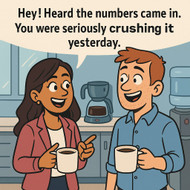
Maya: Hey! You totally crushed it yesterday. That launch presentation was so smooth.
Alex: Thanks. I appreciate that. Honestly, I was wrecked by the end of the day. Barely slept the night before.
Maya: Yeah, I saw your Slack at like 2:30 a.m. I thought you were gonna bail on the kickoff call.
Alex: I almost did. I even pinged Samantha to see if she could cover for me, but she totally ghosted me.
Maya: Classic Samantha. She’s been such a flake lately. Total no-show again this morning. Anyway, I think the launch looked great, but that internal follow-up meeting afterward? Total drag.
Alex: Right? I was ready to bounce after the first 15 minutes. Same slides, same talking points.
Maya: Yeah, but your campaign pivot idea? Total boss move. You pitched it so casually, but it totally landed.
Alex: It was definitely a bit of a flex. I’d been holding onto that idea since last week and was just waiting for the right moment to share it.
Maya: Well, it paid off. Now leadership wants a full deep dive on it in Thursday’s strategy session. Better start prepping.
Alex: Low-key dreading that already.
Maya: Same. And of course I’ve got back-to-back budget meetings that day, too.
Alex: Ugh, that’s a bummer! I owe you coffee after we survive Thursday.
Maya: Deal. But I’m bouncing now before someone ropes me into another “quick update.” Catch you later!
Workplace slang flashcards
Think of the meaning, then click a card to check yourself.
0 of 16 cards open
Crushing it
Meaning: Doing extremely well.
Example: Zoe’s been crushing it since she joined. Her campaign got 10,000 signups in one week!
Wrecked
Meaning: Totally exhausted or drained, in this context.
Example: I pulled an all-nighter and showed up to work absolutely wrecked.
Bail
Meaning: Cancel plans or leave, often unexpectedly. You can bail on a meeting.
Example: We were all set for the pitch, and then Marcus bailed. No call, no message.
Ping
Meaning: Send someone a quick message through workplace chat or email.
Example: If anything changes with the timeline, just ping me.
Ghosted
Meaning: Stopped communicating without explanation. One delayed reply does not necessarily count.
Example: That investor completely ghosted us after the Zoom call.
Classic
Meaning: Typical or characteristic behavior. The tone can be affectionate, amused, or sarcastic.
Example: The printer jammed again five minutes before the meeting. Classic.
Flake
Meaning: An unreliable person who cancels plans or does not follow through. This is a negative label.
Example: Don’t put Joe in charge of the deadline. He’s kind of a flake!
No-show
Meaning: Someone who does not arrive for an expected meeting, appointment, or event.
Example: I sent an invitation and a reminder, but she was a no-show.
Drag
Meaning: A boring, tiring, or unpleasant experience.
Example: That meeting was a complete drag. We spent 40 minutes talking about font sizes.
Bounce
Meaning: Leave. This is a very informal expression.
Example: As soon as the last slide went up, half the team bounced.
Boss move
Meaning: A confident, bold, or impressive action. The person does not have to be the boss.
Example: She challenged the VP’s numbers in front of everyone. Total boss move.
Flex
Meaning: To show off, or an act of showing off. It can sound admiring, playful, or critical.
Example: Max mentioned finishing the project over the weekend. It was a clear flex.
Deep dive
Meaning: A thorough, detailed examination of a topic. This is common workplace jargon.
Example: Let’s do a deep dive into user feedback before changing the homepage.
Low-key
Meaning: Expressing a feeling or opinion in an understated way. It can suggest “slightly,” “secretly,” or “I don’t want to make a big deal of this.”
Example: I’m low-key nervous about my presentation.
Bummer
Meaning: A disappointment or unfortunate situation, usually a relatively minor problem.
Example: They moved the launch back two weeks. That’s a bummer.
Like
Meaning: A conversational word that can approximate a number, mark a pause, or introduce someone’s words or reaction.
Examples: “It was like 2:30 a.m.” means approximately that time. “I was like, ‘Are we launching today?’” introduces a reaction.
You do not need to deliberately add like to your speech to sound natural.
Test your workplace slang skills
The interactive quiz requires JavaScript. You can still explore all the flashcards above.
Keep learning the English Americans use at work
Enjoyed this lesson? Subscribe to Speak Business English Like an American on Substack for practical expressions, workplace conversations, cultural insights, and quizzes from Amy Gillett.
Choose a free or paid subscription and keep building your confidence in English.
Explore American slang beyond the office
Interested in the informal English of American college life? Explore American College Slang from Language Success Press.
College slang belongs to a more casual setting. Learning it can help you understand informal conversations, but not every expression is appropriate at work.
Explore American College Slang →Try one expression this week
Choose an expression that fits your workplace. Listen for how others use it, then try it in a suitable conversation. Start with something straightforward, such as “I’ll ping you when it’s ready.”
Try a speaking challenge
Say these sentences aloud, then change the details to fit your own work:
- “You crushed it in that presentation.”
- “I’ll ping you when the report is ready.”
- “Let’s do a deep dive into the customer feedback.”
For an extra challenge, explain each expression without using the expression itself.
For more free lessons, visit our English Learning Hub. For structured workplace practice, explore Speak Business English Like an American.